|
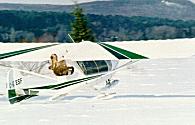
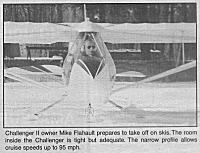
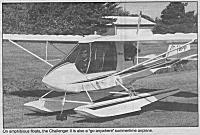
Imagine driving out to the local airport on a clear day in March; You don't have to use the runway. The hangar doesn't have to be at an airport, neither does the destination. Any oversize backyard or pond will do. Your aircraft is equally at home on amphibious floats. This is advanced ultralight flying in a Challenger. The nearest certified airplane that will perform close to the Challenger on skis and amphibious floats is a Cessna 185 or a Maule. Notice I use the word "close" and not "as good as". The versatility of today's ultralights for recreational flying may be the best kept secret in aviation. Ian Coristine of National Ultralight, Ski flying is a good way to start that education. Empty, the fully equipped Challenger weighs about 400 pounds. If two people double that weight, the airplane is still light enough that it is impossible to get it stuck in snow. The nose ski prevents the Challenger from tipping over if it bogs down and there is no danger of clipping the pusher propeller since it's in the back. Hot air from the engine keeps the cockpit warm. There is room in the airplane for instruments and radios. This is a true "go anywhere" machine. For my Challenger education, I departed with Coristine on skis from
his snow-filled hangar at the St. Lazare Airport in Quebec. We flew along
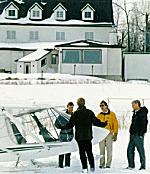
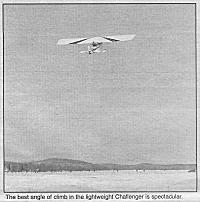
the picturesque Ottawa Valley at ultralight height Then we zoom climbed to altitude so ex-glider pilot Coristine could demonstrate the Challenger's soaring abilities with the engine shut down. He flew a deadstick landing on the river for a lunch stop at the trendy Willows Inn in Hudson, Quebec. TOO MUCH FUN In the afternoon, we traded seats The basic controls are a stick and rudder pedals. The Challenger employs full-span flaperons for roll control, pitch trim and flaps. Moving the stick side-to-side operates the flaperons differentially for roll control. There is a crank handle on the ceiling reminiscent of Piper trim controls that operates the flaperons up and down together. The first half of the adjustment acts as a pitch trim control and the second half extends the flaperons as flaps, lowering the stall speed by five mph. The fact that the Challenger sits tail down when empty is a simple weight and balance control designed into the airplane. If the Challenger will not come down on its nose ski or wheel when you get in then it is loaded too far aft, which would happen if someone tried to fly it solo from the back seat. The beauty of the Challenger's engine is that it was refined for aircraft use from a snowmobile engine. Its only fluid is mixed fuel and gas. It was designed to start and go in -40C temperatures. Coristine tells a story of a Challenger Association winter fly-in where seven members flew and the rest drove. After an exceptionally cold night, none of the cars would start and all of the Challengers did. We started Coristine's Challenger in front of the Willows and took off. Conventional airplane pilots need to leave some of what they know at home when first flying a Challenger. The airplane has a power-to-weight ratio much better than most light planes. Takeoff acceleration is quick and it's easy to get behind the airplane. We were off in a hop, and a skip. I was waiting for the jump. The Challenger's 40-mph best angle of climb "Try it," he said. I set up a climb, throttled off and held the stick back. The airplane mushed forward on its own and flew into a descent. I tried full stalls. The same thing happened. The airplane doesn't appear to have low speed vices. The front seat is the best one in the house. The cockpit hangs out ahead of the wing offering excellent visibility even in turns. There is a down side to this extra fuselage keel surface ahead of the wing. If the Challenger is not flown perfectly straight the extended nose catches the relative airflow on one side. It makes this a rudder airplane even in straight flight. I found that I overcontrolled the rudder trying to fly a constant heading. Coristine says you quickly get the hang of it with practice. Turns require conventional aircraft pilots to rediscover their rudder if they want to be coordinated. Setting maximum power produced 95 mph in level flight and lots of noise. A more comfortable cruise rpm gave 85 mph. The most fun was when we cruised along enjoying the scenery at 60 mph/5000 rpm. It is a fantastic sense of freedom to think you can land just about anywhere with snow-covered ground or ice-covered water. I tried a couple of off-airport landings on the Ottawa River, one with the engine shut down. They were conventional except in the amount of space required. Each one was a hop and a skip to a stop. The Challenger can be sideslipped to land on a dime and give change. When we were walking away from the airplane, Coristine looked at my bulk and said that the Challenger II flew even better with just one person on board.
Most new Challengers are registered as Advanced Ultralights which allows pilots who have a Recreational Pilot permit or higher licence to fly with a passenger. Pilots with an Ultralight Permit fly solo or with another licensed pilot. The airplane may be flown day VFR only. Owner maintenance is allowed as long as it follows the manufacturer's recommendations. The Challenger II also qualifies to be assembled as an amateur-built aircraft. The typical Challenger customer With some 500 Challengers registered in Canada, the secret is getting out.
To learn and see more order our comprehensive information package and video! |